Naresh Varnakavi, Ph.D.MATERIALS SCIENTIST

RESEARCH / THROUGH THE FIGURES

Small stories.
Real materials science.

Explore the question, understand the principle, and discover why the result matters. Conceptual guides and figures connect each highlight to the published evidence.

15 illustrated stories39 journal articles in the publication index

Original conceptual guide: Dual-ligand treatment → Surface passivation → Brighter blue emission

Perovskite Nanomaterials / 2025

Two ligands. Fewer surface losses.

Blue-emitting nanoplatelets expose a large fraction of their atoms at the surface. DDAB supplies bromide for vacancy passivation, while HPA coordinates undercoordinated lead; together they suppress pathways that dissipate excitation without light.

Why it matters Complementary surface chemistry can make blue perovskite emission both brighter and more stable.

V. Naresh, J. L. Velpugonda, A. Kala, M. Yerich, D. Jones, Z. Xing, N. Sharvirala, A. Majumdar, L.Y. Lin, Defect Passivation via Dual-Ligand Surface Modification for Bright and Stable Blue Emission in CsPbBr3 Nanoplatelets, Adv. Opt. Mater. 2025, e01375

Read the paper
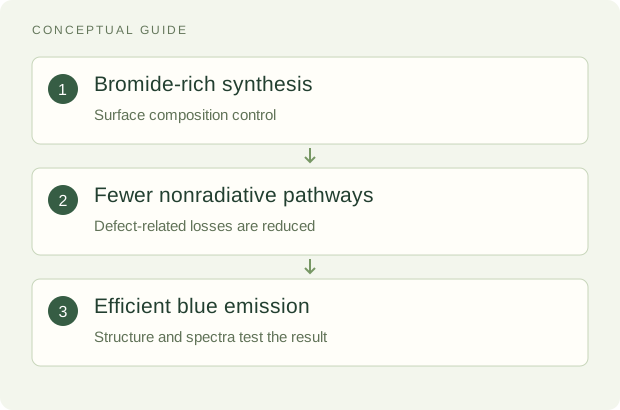
Original conceptual guide: Bromide-rich synthesis → Fewer nonradiative pathways → Efficient blue emission

Perovskite Nanomaterials / 2024

Bromide-rich surfaces brighten blue emission.

Thin perovskite nanoplatelets are sensitive to surface halide defects. Introducing ZnBr2 during synthesis increases bromide availability and changes the balance between carrier trapping and light emission.

Why it matters Precursor chemistry offers a route to control the surface while the nanocrystal forms.

V. Naresh, J.L. Velpugonda, N. Lee, S.H. Nah, L.Y. Lin, In Situ Synthesis of Br‐Rich CsPbBr3 Nanoplatelets: Enhanced Stability and High PLQY for Wide Color Gamut Displays, Adv. Funct. Mater., 35 (2024) 2413320

Read the paper
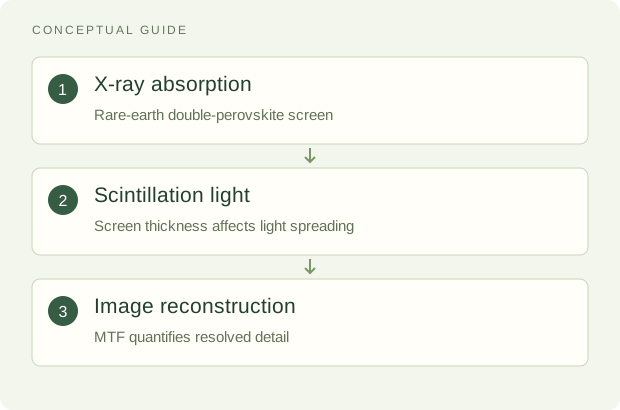
Original conceptual guide: X-ray absorption → Scintillation light → Image reconstruction

X-ray Scintillators / 2024

A thinner screen reveals finer X-ray detail.

A scintillator must absorb X-rays and deliver visible light without excessive lateral spreading. In Tb3+-doped Cs2NaGdCl6, dopant emission provides the light-conversion channel, while screen thickness changes imaging sharpness.

Why it matters Screen geometry matters alongside the chemistry of the emitter.

V. Naresh, P.R. Cha, and N. Lee, Cs2NaGdCl6:Tb3+─A Highly Luminescent Rare-Earth Double Perovskite Scintillator for Low-Dose X-ray Detection and Imaging, ACS Appl. Mater. Interfaces 16 (2024) 19068-80

Read the paper
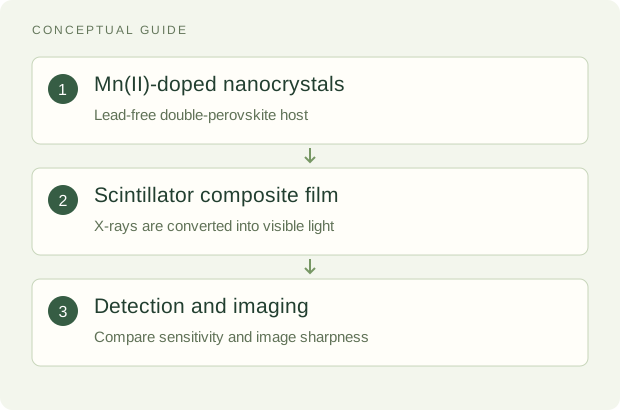
Original conceptual guide: Mn(II)-doped nanocrystals → Scintillator composite film → Detection and imaging

X-ray Scintillators / 2024

Seeing the hidden structure of everyday objects.

Mn2+ doping introduces a luminescent pathway in lead-free Cs2NaBiCl6 nanocrystals. Embedding these emitters in PMMA creates a scintillator film that converts transmitted X-rays into a visible image.

Why it matters Scintillator performance needs both a bright material and evidence that fine features remain distinguishable.

V. Naresh, R. Ramaraghavulu, Kiran Gupta, P.R. Cha, and N. Lee, Scintillation Performance of Mn (II)-doped Cs2NaBiCl6 Double Perovskite Nanocrystals for X-ray imaging applications, Adv. Opt. Mater., 12 (2024) 2301868

Read the paper
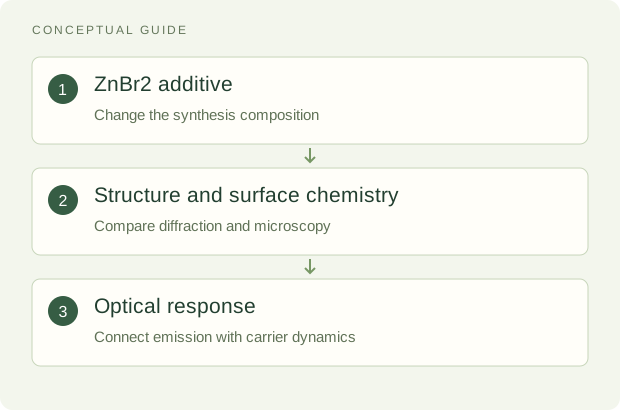
Original conceptual guide: ZnBr2 additive → Structure and surface chemistry → Optical response

Perovskite Nanomaterials / 2023

An additive changes more than the brightness.

Adding ZnBr2 to CsPbBr3 nanocrystals changes surface chemistry and can also redirect phase formation toward Cs4PbBr6-containing structures. Composition, phase, and optical response therefore have to be evaluated together.

Why it matters A passivating additive can become a phase-control variable as its concentration increases.

V. Naresh, Kiran Gupta, P.R. Cha, and N. Lee, Compositional engineering of ZnBr2-doped CsPbBr3 perovskite nanocrystals: insights into structure transformation, optical performance, and charge-carrier dynamics, J. Mater. Chem. C 11 (2023) 14248

Read the paper
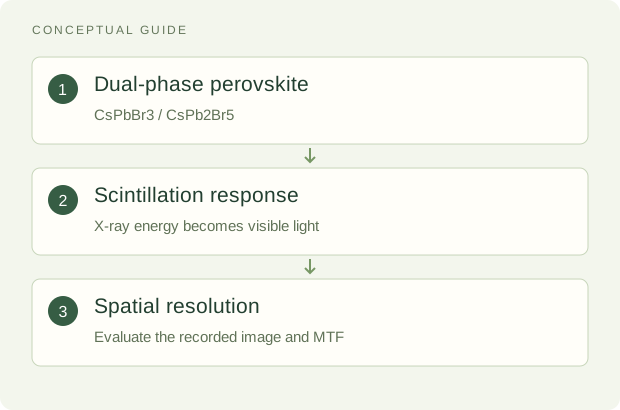
Original conceptual guide: Dual-phase perovskite → Scintillation response → Spatial resolution

X-ray Scintillators / 2023

Two phases improve the X-ray image.

A CsPbBr3–CsPb2Br5 architecture combines an emissive perovskite with a second phase that changes its environment and stability. The scintillator screen converts the X-ray transmission pattern into visible contrast.

Why it matters Engineering the surrounding phase can improve the usefulness of an emitting nanocrystal.

V. Naresh, S. Singh, H. Soh, J. Lee, and N. Lee, Dual-phase CsPbBr3-CsPb2Br5 perovskite scintillator for sensitive X-ray detection and imaging, Mater. Today Nano 23 (2023) 100364

Read the paper
Original conceptual guide: Ultrafast excitation → Carrier evolution → Transient absorption

Crystals & Phosphors / 2022

Watching excited carriers in dual-phase crystals.

A material’s emission depends on how photoexcited carriers relax. Comparing CsPbBr3 with CsPbBr3/Cs4PbBr6 microcrystals connects their phase architecture to transient optical signatures and carrier evolution.

Why it matters Time-resolved spectroscopy helps explain why two materials with related chemistry emit differently.

V. Naresh, T. Jang, Y. Pan, and N. Lee, Highly luminescent dual-phase CsPbBr3/Cs4PbBr6 microcrystals for wide color gamut for backlight display, Nanoscale 14 (2022) 17789

Read the paper
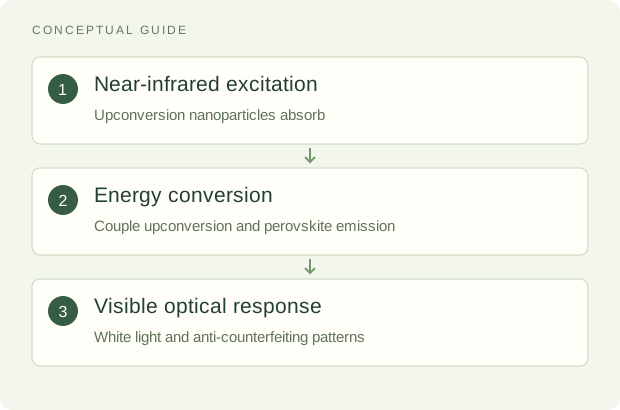
Original conceptual guide: Near-infrared excitation → Energy conversion → Visible optical response

Perovskite Nanomaterials / 2022

Infrared light, converted twice.

NaYF4:Yb,Tm@NaYF4 nanoparticles convert 980 nm excitation into visible photons. Perovskite nanocrystals then reabsorb part of that emission, producing an additional color through radiative photon transfer.

Why it matters Combining emitters creates excitation-dependent optical signatures for authentication.

V. Naresh, V.N.K.B. Adusumalli, Y.I. Park, N. Lee, NIR-triggered NaYF4:Yb3+, Tm3+ @ NaYF4/CsPb(Br1-x/Ix)3 composite for up-converted white-light emission and dual-model anti-counterfeiting applications, Mater. Today Chem. 23 (2022) 100752

Read the paper
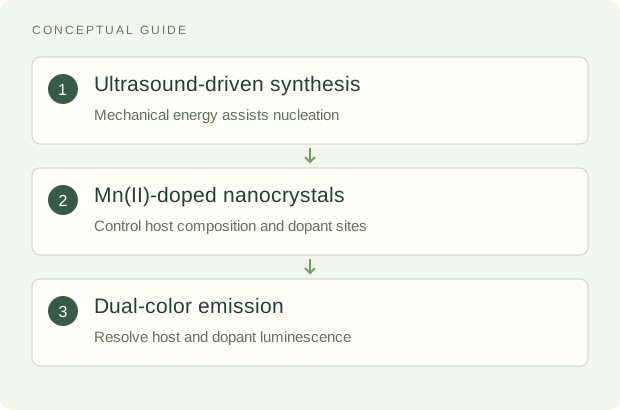
Original conceptual guide: Ultrasound-driven synthesis → Mn(II)-doped nanocrystals → Dual-color emission

Perovskite Nanomaterials / 2023

Ultrasound connects synthesis and dopant emission.

A polar-solvent-free sonochemical route produces Mn-doped CsPbCl3 nanocrystals. Excitation of the host can feed Mn2+ centers, creating a second emission channel alongside the perovskite response.

Why it matters Dopant incorporation and the synthesis environment can be designed together.

V. Naresh, M.K. Cho, P.R. Cha, and N. Lee, Polar-Solvent-Free Sonochemical Synthesis of Mn(II)-Doped CsPbCl3 Perovskite Nanocrystals for Dual-Color Emission, ACS Appl. Nano Mater. 2023, 6, 4693-4706

Read the paper
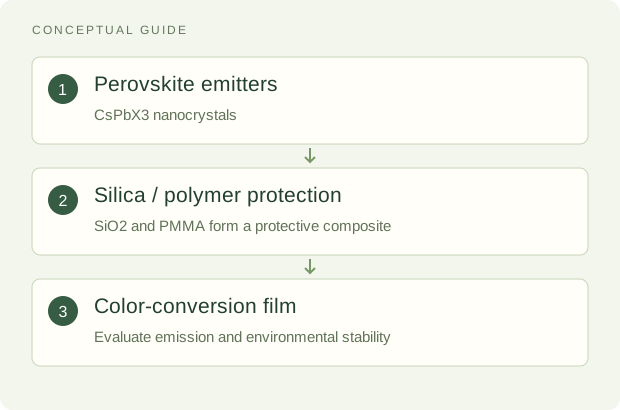
Original conceptual guide: Perovskite emitters → Silica / polymer protection → Color-conversion film

Polymers & Composites / 2021

Protecting nanocrystals without losing their color.

Perovskite emission is vulnerable to moisture and ion exchange. A silica shell and PMMA matrix provide complementary barriers around the nanocrystals while preserving their color-conversion function.

Why it matters Encapsulation turns a sensitive emitter into a more usable composite film.

V. Naresh, B.H. Kim, N. Lee, Synthesis of CsPbX3 (X = Cl/Br, Br, and Br/I)@SiO2/PMMA composite films as color-conversion materials for achieving tunable multi-color and white light emissions, Nano Res. 14 (2021) 1187-1194

Read the paper
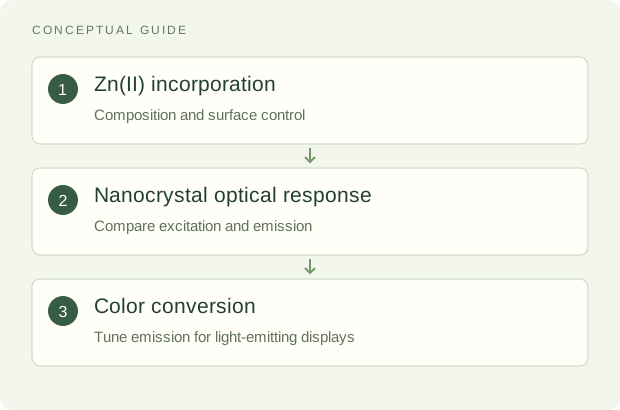
Original conceptual guide: Zn(II) incorporation → Nanocrystal optical response → Color conversion

Perovskite Nanomaterials / 2020

Doping opens a route to color control.

Zn(II) incorporation changes the local environment of cesium lead halide nanocrystals. The study relates this compositional modification to their emission efficiency and color-conversion behavior.

Why it matters Composition provides a handle for controlling the optical response of a nanocrystal.

V. Naresh, N. Lee, Zn(II)-Doped Cesium Lead Halide Perovskite Nanocrystals with High Quantum Yield and Wide Color Tunability for Color-Conversion Light-Emitting Displays, ACS Appl. Nano Mater. 3 (2020) 7621-7632

Read the paper
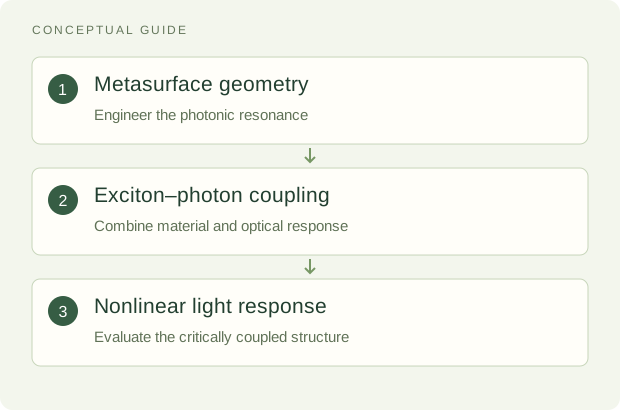
Original conceptual guide: Metasurface geometry → Exciton–photon coupling → Nonlinear light response

Photonics & Patterning / 2025

Geometry strengthens light–matter interaction.

A patterned FAPbBr3 film acts as both the excitonic material and the optical resonator. Controlled asymmetry tunes a quasi-bound-state-in-the-continuum mode toward critical coupling, strengthening the interaction of light with matter.

Why it matters The collaborative study demonstrates few-photon nonlinearity; my contributions included materials synthesis, characterization, and device fabrication.

J. Fang, A. Kala, R. Johnson, D. Sharp, R. Chen, C. Chang, C. Munley, J. Fröch, V. Naresh, A. Tang, A. Manna, V. Tara, B. Datta, Z. Zhou, D. Ginger, V. Menon, L.Y. Lin, A. Majumdar, Free Space Few-Photon Nonlinearity in Critically Coupled Polaritonic Metasurfaces, Nat. Commun. 16 (2025) 10099

Read the paper
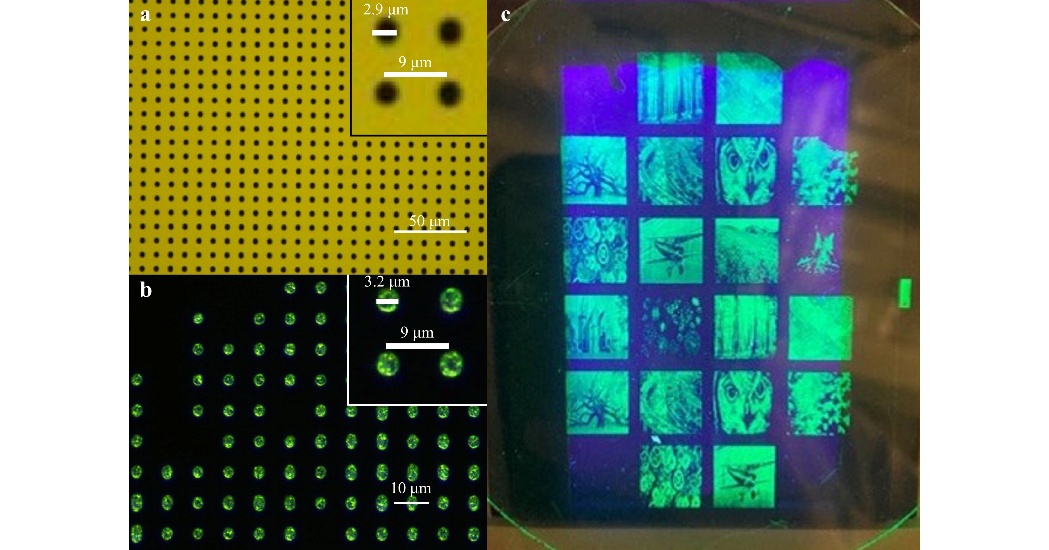
Microscopy and fluorescent images show patterned features and a multicolor array on a 100 mm wafer.

Photonics & Patterning / 2025

From a glowing film to a defined pattern.

Integrating solution-processed emitters requires spatial control without sacrificing optical quality. A dry photolithographic lift-off method patterns the materials into small features and supports multicolor integration.

Why it matters Patterning connects materials chemistry to the spatial requirements of optoelectronic devices.

J.L. Velpugonda, V. Naresh, Y. Matthew, and L.Y. Lin, A Universal High-Resolution Micro-Patterning Technique for Solution-Processed Materials, Light: Adv. Manuf. 6 (2025) 228-235

Read the paper
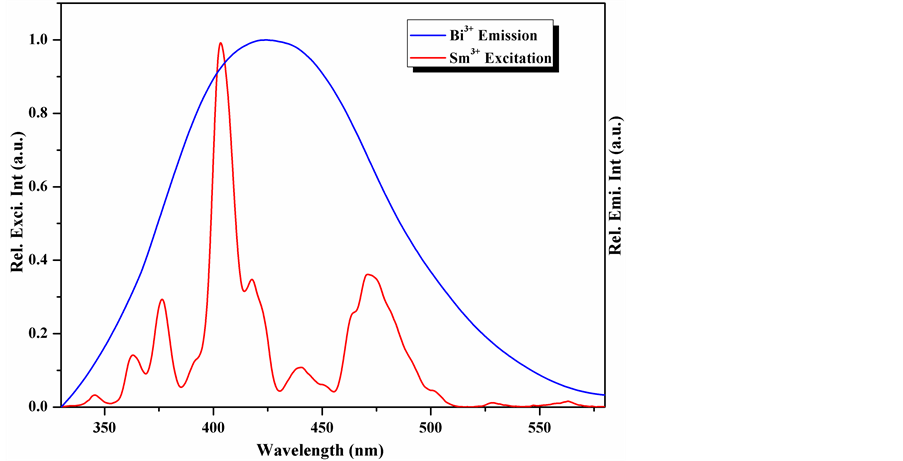
The blue donor-emission band overlaps the red acceptor-excitation spectrum. Emission and lifetime measurements in the paper provide additional evidence for sensitization. Figure 3: Reddy et al., 2014 (CC BY 4.0).

Glasses / 2014

One ion harvests energy. Another emits it.

In Bi3+/Sm3+-doped phosphate glass, the sensitizer and activator must have compatible optical transitions. The overlap of Bi3+ emission with Sm3+ excitation provides a pathway for energy transfer and enhanced orange emission.

Why it matters Selecting a compatible dopant pair can redirect excitation energy within an optical glass.

C. Parthasaradhi Reddy, V. Naresh, B. Chandra Babu, S. Buddhudu, Photoluminescence and Energy Transfer Process in Bi3+/Sm3+ Co-Doped Phosphate Zinc Lithium Glasses, Adv. Mater. Phys. Chem. 4 (2014) 165-171

Read the paper
Original conceptual guide: Polymer host → Ionic modification → Material response

Polymers & Composites / 2011

How ions move through a polymer film.

Adding Li+ or Ag+ to solution-cast PVP changes its electrical response. Temperature-dependent conductivity probes the thermally activated motion of charge through the polymer–ion system.

Why it matters Transport measurements help relate a polymer’s composition to its potential as an ionic material.

K. Sivaiah, K. Naveen, V. Naresh, S. Buddhudu, Structural and Optical Properties of Li+: PVP & Ag+: PVP Polymer Films, Mater. Sci. & Appl. 2 (2011) 1688-1696

Read the paper
Browse every publication