Naresh Varnakavi, Ph.D.MATERIALS SCIENTIST

Materials Synthesis

From precursors to purposeful materials...

Fifteen routes to making materials-each with its own illustration, working principle, and experimental controls.

In my research...

My work spans melt-quenched optical glasses; sol–gel and co-precipitation routes; colloidal nanocrystals made by hot-injection, LARP, sonochemical, hydrothermal, and recrystallization methods; and solid-state and molten-salt processing of MAX phases. Surface passivation, encapsulation, selective etching, intercalation, and delamination connect synthesis to functional materials.

Explore my research experience ↗

Explore 15 synthesis methods through original scientific schematics. Each diagram explains a general principle; operating conditions depend on the material and experiment.

Jump to a synthesis method

15 methods

01

Hydrothermal synthesis

Water-based crystal growth
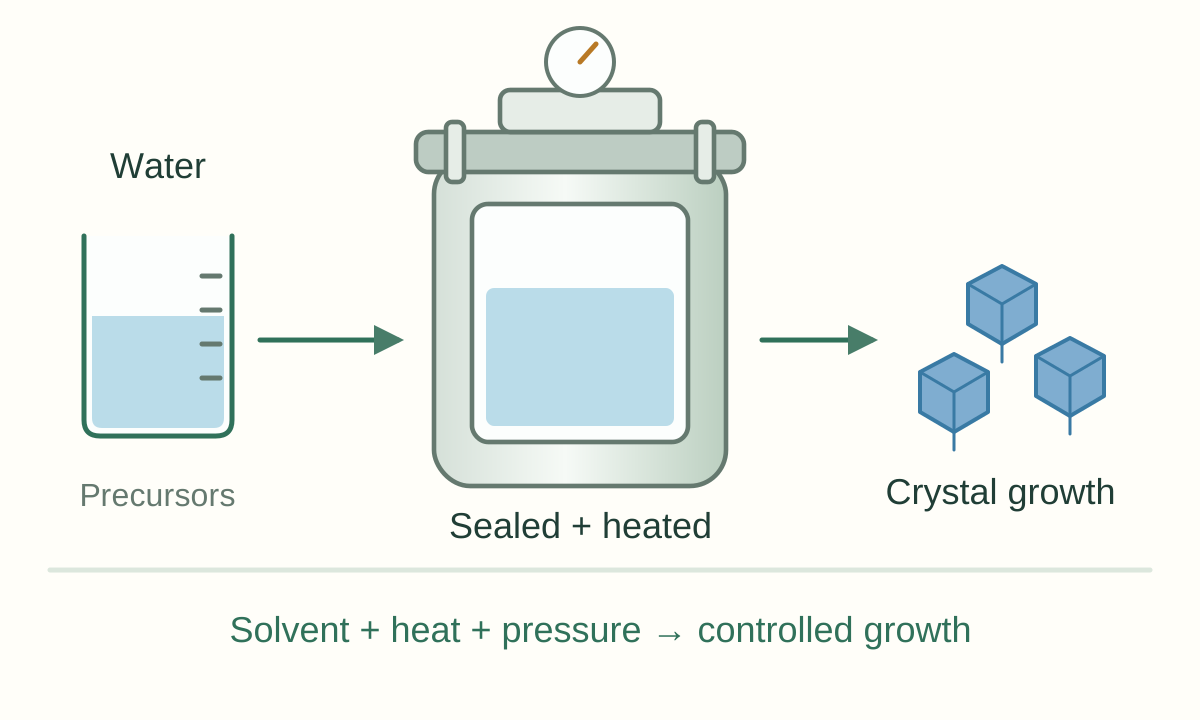
Hydrothermal synthesis: Water-based crystal growth. Clear vector schematic of the basic process.
Scientific principle schematic · tap to enlarge

Principle

Precursors react in water inside a sealed, heated vessel. Elevated temperature and the resulting pressure change solubility and reaction kinetics, allowing nucleation and crystal growth. Temperature, pH, precursor concentration, and reaction time help select particle size, shape, and phase.

Outcome

Crystalline oxides, phosphors, and other water-compatible materials.

What controls the outcomeSolvent chemistry and pressure-vessel constraints determine whether this route suits a particular composition.

Read the scientific principle ↗
02

Solvothermal synthesis

Crystal growth in a selected solvent

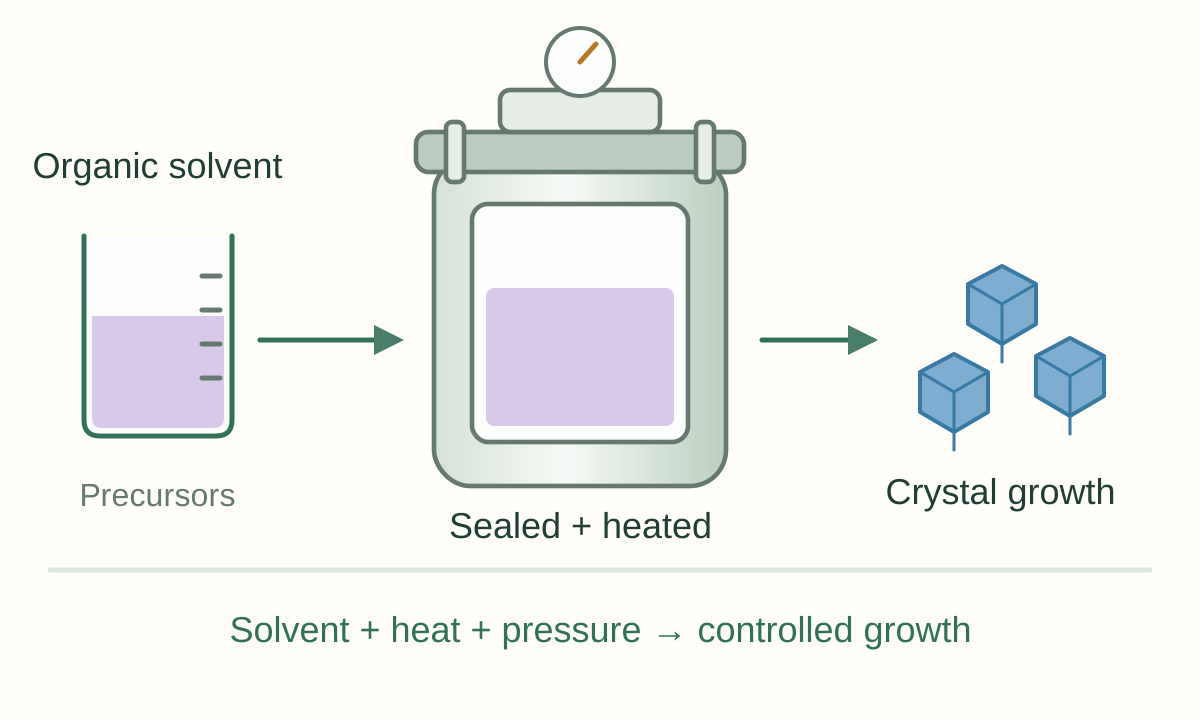
Solvothermal synthesis: Crystal growth in a selected solvent. Clear vector schematic of the basic process.
Scientific principle schematic · tap to enlarge

Principle

A sealed reactor heats precursors in a nonaqueous solvent or solvent mixture. Solvent coordination, polarity, and solubility influence nucleation and growth, while ligands can stabilize particular crystal surfaces. Changing the solvent therefore changes both the reaction environment and the final morphology.

Outcome

Nanocrystals, coordination materials, and solvent-sensitive compositions.

What controls the outcomeSolvent choice, filling fraction, temperature, and time must be optimized together.

Read the scientific principle ↗
03

Sol–gel method

From molecular precursors to a connected network

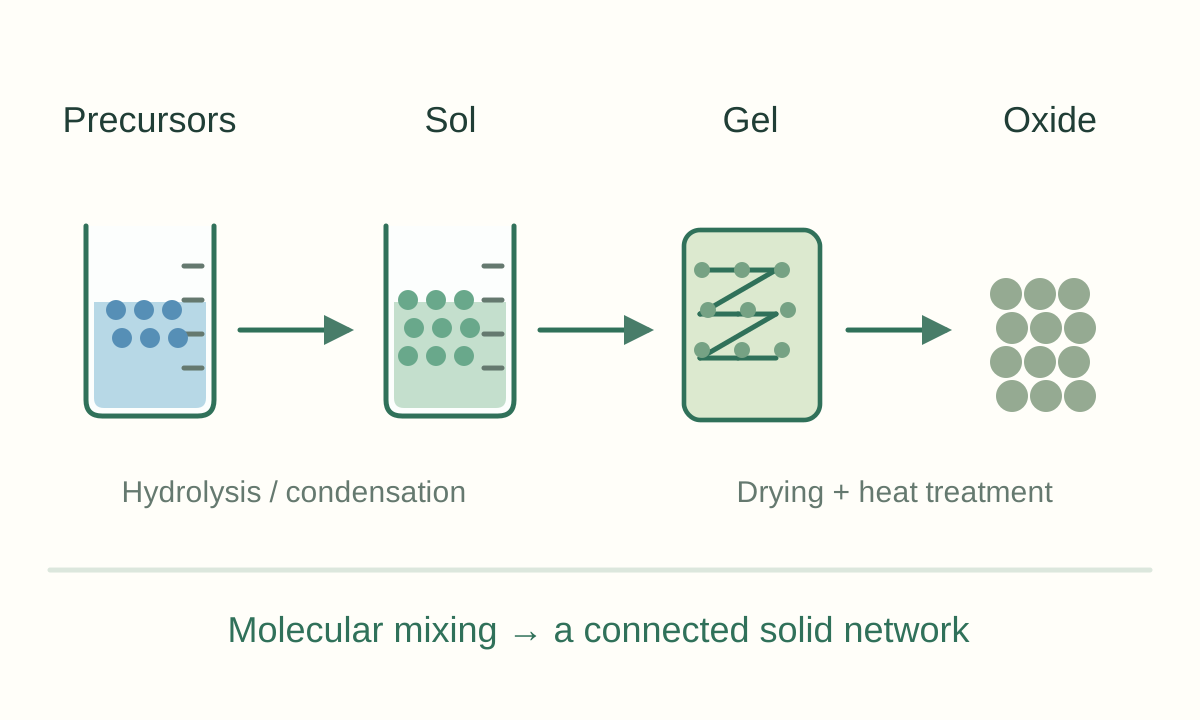
Sol–gel method: From molecular precursors to a connected network. Clear vector schematic of the basic process.
Scientific principle schematic · tap to enlarge

Principle

In a common alkoxide route, hydrolysis creates reactive hydroxyl groups and condensation links them into an inorganic network. A liquid sol evolves into a gel, which is then dried; heat treatment can remove organics and develop the desired phase. Mixing at the precursor level helps distribute components before the solid is formed.

Outcome

Oxide powders, coatings, and hybrid inorganic–organic networks.

What controls the outcomeHydrolysis rate, water content, pH, and drying affect homogeneity, shrinkage, and cracking.

Read the scientific principle ↗
04

Co-precipitation

Forming a solid from dissolved ions

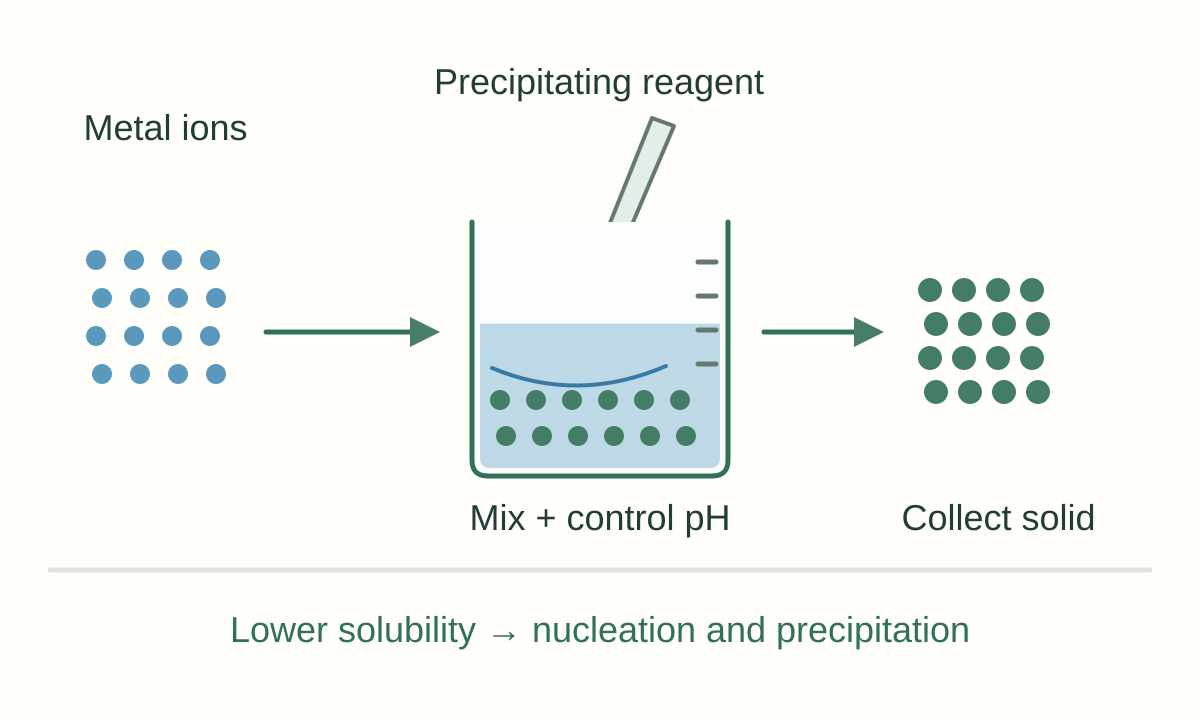
Co-precipitation: Forming a solid from dissolved ions. Clear vector schematic of the basic process.
Scientific principle schematic · tap to enlarge

Principle

A precipitating reagent changes solution conditions so dissolved ions form an insoluble solid. Controlled mixing and pH help the components precipitate together, followed by aging, washing, and drying. A later heat treatment may transform a hydroxide or other precursor into the target oxide phase.

Outcome

Mixed hydroxide or oxide precursors and magnetic nanoparticles.

What controls the outcomeDifferent ions do not always precipitate at the same rate; composition and residual salts need verification.

05

Electrodeposition

Electrochemistry builds a surface layer

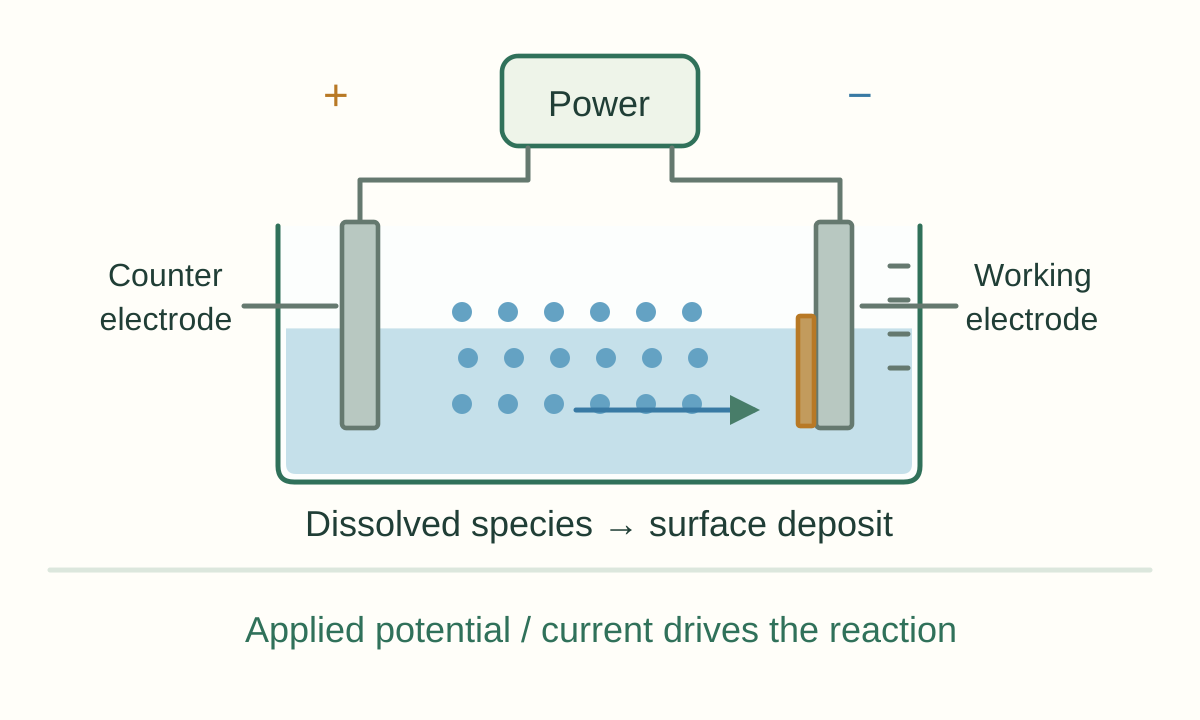
Electrodeposition: Electrochemistry builds a surface layer. Clear vector schematic of the basic process.
Scientific principle schematic · tap to enlarge

Principle

An applied potential or current drives an electrochemical reaction at a conductive substrate immersed in an electrolyte. Reacting species form a deposit on the working electrode while a counter electrode completes the circuit. Bath chemistry and the electrical program govern nucleation, growth, and film morphology.

Outcome

Metal, alloy, oxide, or conducting-polymer coatings, depending on the electrolyte and reaction.

What controls the outcomeCurrent distribution, substrate preparation, and competing reactions influence thickness and uniformity.

Read the scientific principle ↗
06

Chemical vapor deposition (CVD)

A film grows from reactive gases

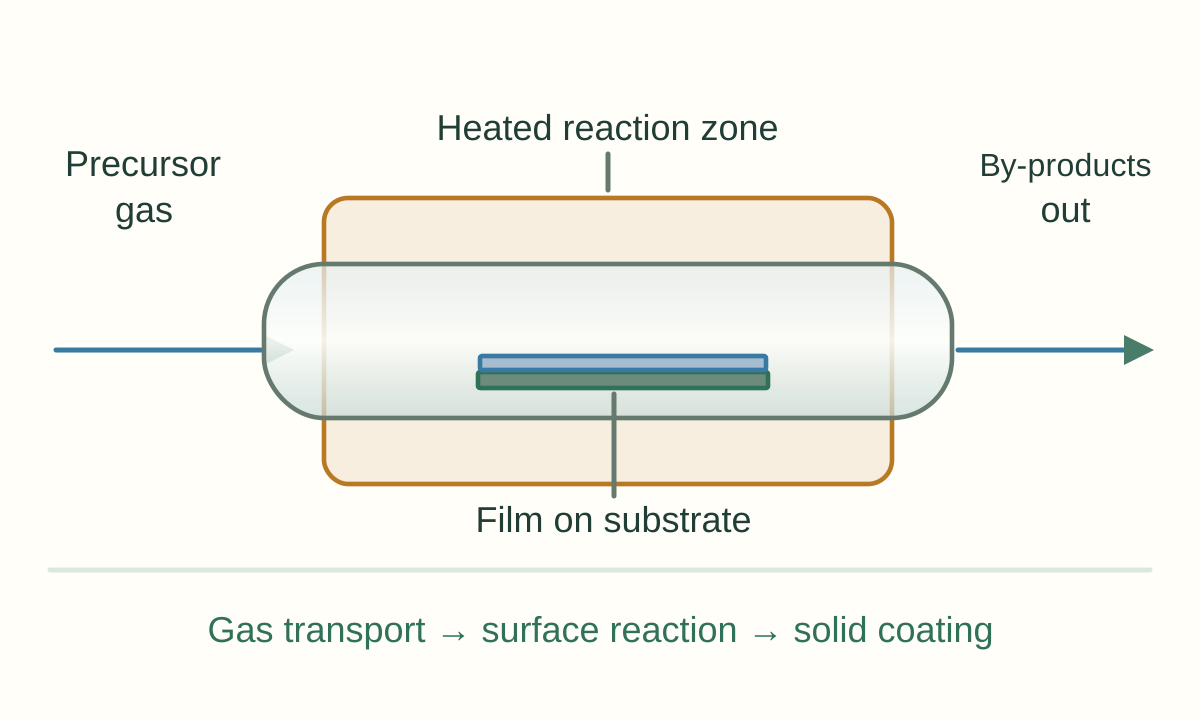
Chemical vapor deposition (CVD): A film grows from reactive gases. Clear vector schematic of the basic process.
Scientific principle schematic · tap to enlarge

Principle

Volatile precursors enter a reactor and reach a substrate, often held at elevated temperature. Surface reactions or precursor decomposition form a solid coating, while gaseous by-products leave the reactor. Gas flow, pressure, temperature, and precursor chemistry determine the deposition regime.

Outcome

Thin films and coatings, with composition set by the precursor and reaction chemistry.

What controls the outcomeUniform growth requires balancing precursor transport with surface reaction rates.

Read the scientific principle ↗
07

Electrospinning

An electric field stretches a jet into fibers

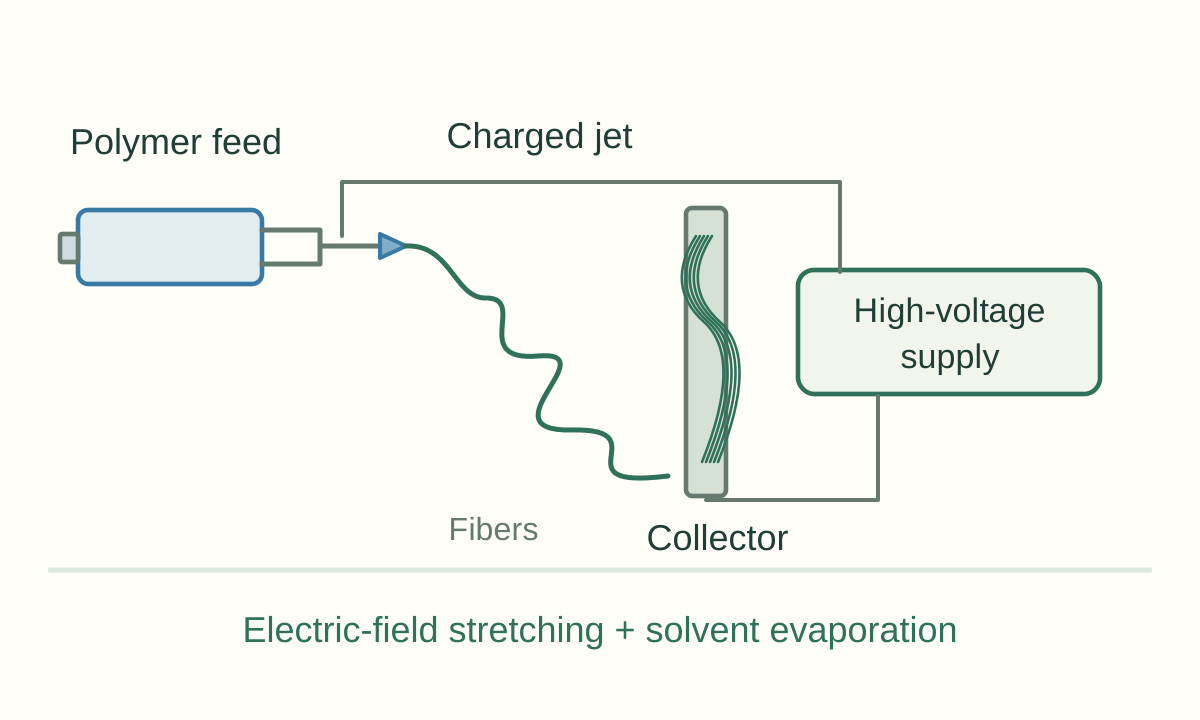
Electrospinning: An electric field stretches a jet into fibers. Clear vector schematic of the basic process.
Scientific principle schematic · tap to enlarge

Principle

A high voltage deforms a droplet at the spinneret into a cone and launches a charged liquid jet. The jet stretches as it travels toward a collector, while solvent evaporates to leave fibers. Polymer entanglement helps keep the jet continuous; suitable composite fibers can be converted into ceramic fibers by subsequent heating.

Outcome

Fibrous polymer or composite mats and precursor fibers for ceramic materials.

What controls the outcomeSolution viscosity, conductivity, flow rate, and collection conditions control fiber quality.

Read the scientific principle ↗
08

Spray pyrolysis

Droplets become particles or a coating

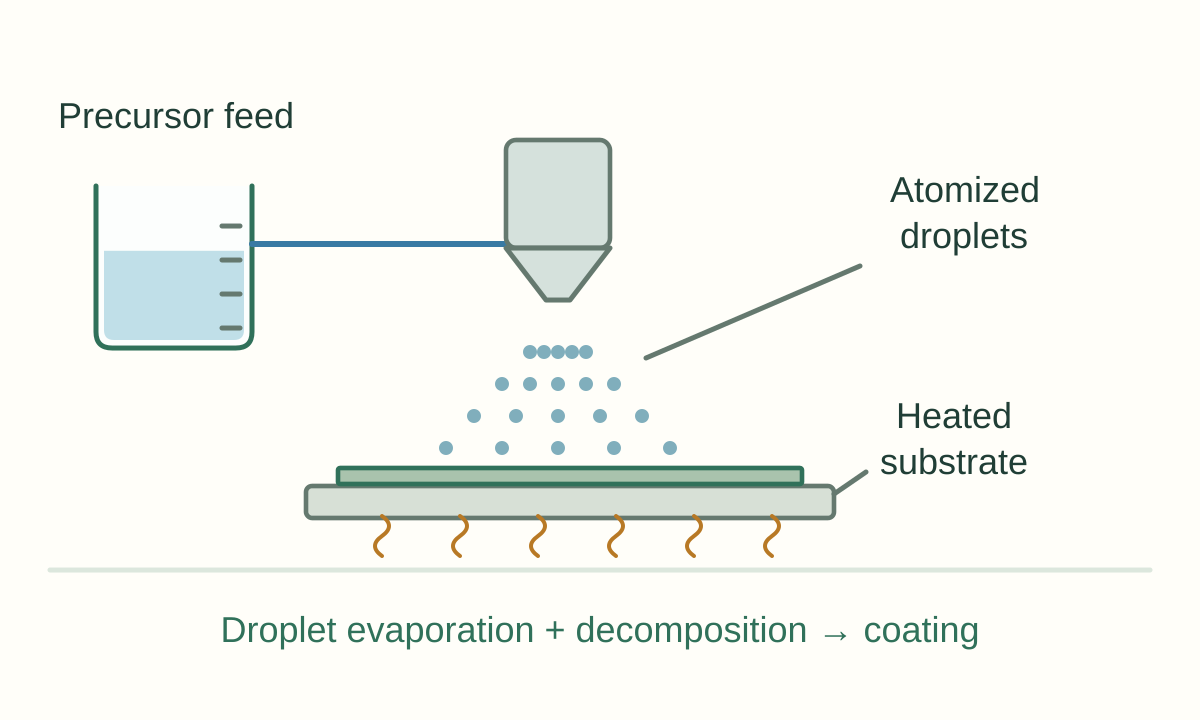
Spray pyrolysis: Droplets become particles or a coating. Clear vector schematic of the basic process.
Scientific principle schematic · tap to enlarge

Principle

An atomizer turns a precursor solution into droplets that travel through a hot region or reach a heated substrate. Solvent evaporation and chemical decomposition convert the droplets into a solid product. The illustration shows the heated-substrate variant, where the material is collected as a coating.

Outcome

Oxide films or powders and other thermally accessible compositions.

What controls the outcomeDroplet size, precursor concentration, residence time, and temperature affect composition and morphology.

Read the scientific principle ↗
09

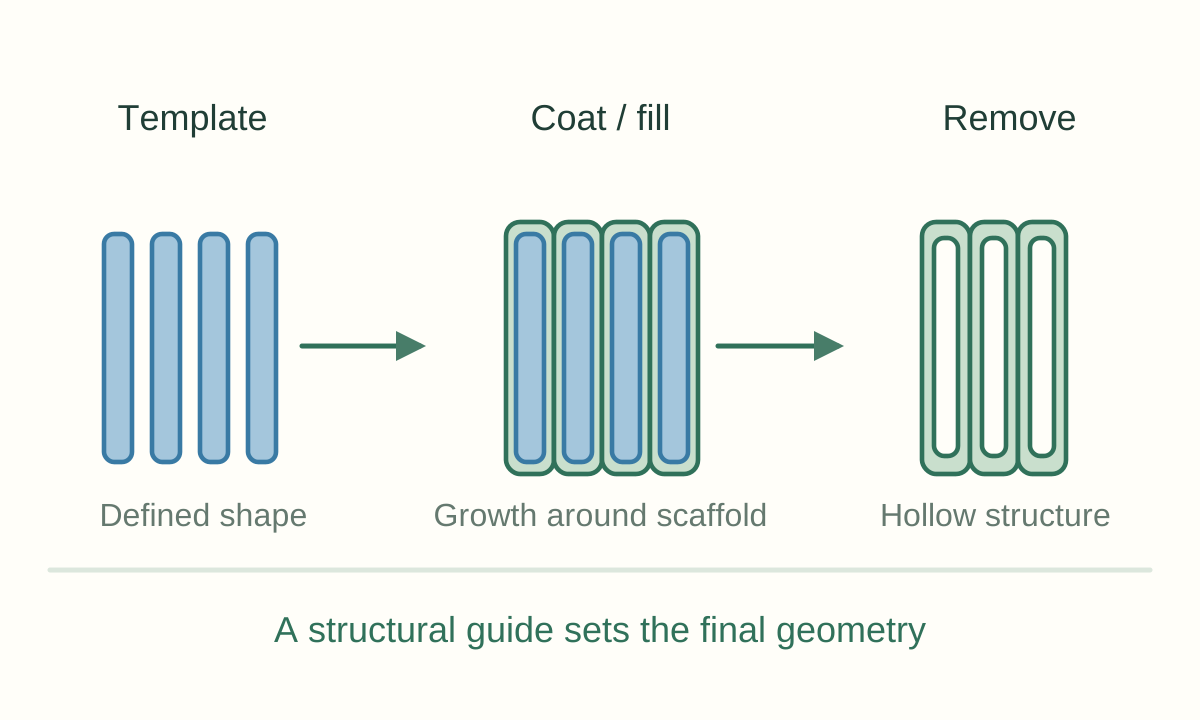
Template-assisted synthesis

A removable structure defines the geometry

Template-assisted synthesis: A removable structure defines the geometry. Clear vector schematic of the basic process.
Scientific principle schematic · tap to enlarge

Principle

A hard scaffold or a soft self-assembled template organizes where a material grows. Precursors fill pores, coat a surface, or form around the template, and the scaffold is then removed or transformed. The final solid can preserve a pore, tube, or hollow shape inherited from that structure.

Outcome

Ordered pores, nanotubes, hollow particles, and structured composites.

What controls the outcomeTemplate removal must preserve the desired structure and avoid residual contamination.

10

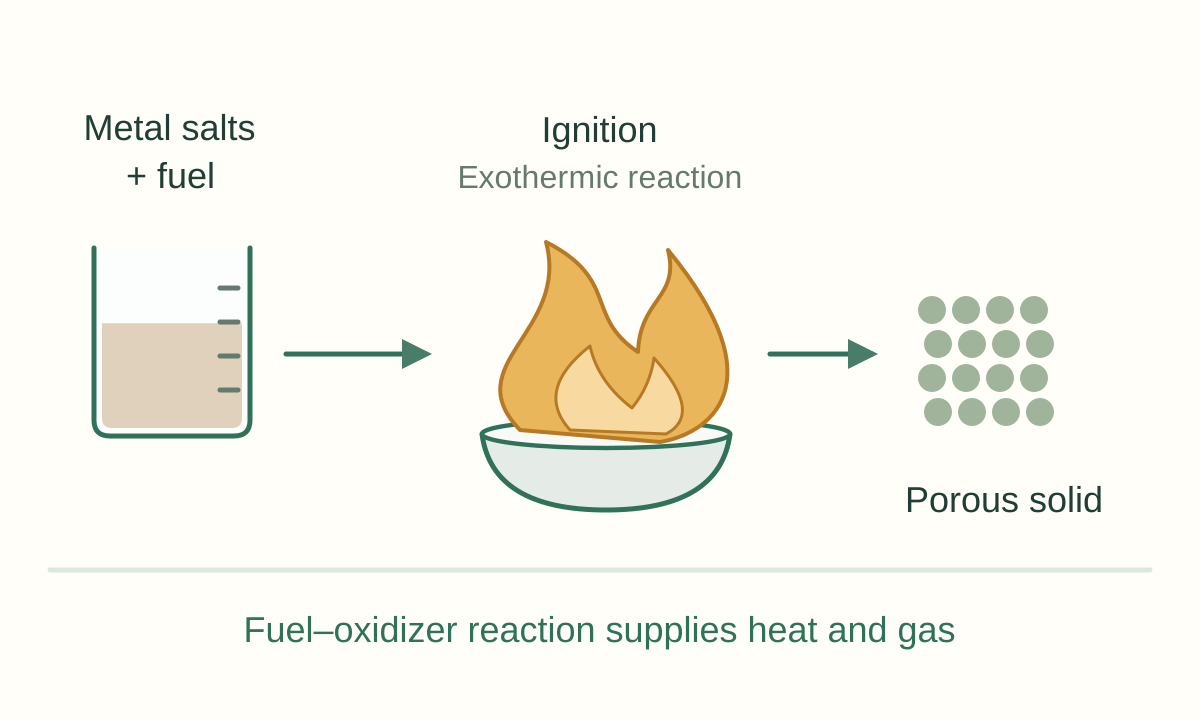
Combustion synthesis

A reactive mixture supplies its own heat

Combustion synthesis: A reactive mixture supplies its own heat. Clear vector schematic of the basic process.
Scientific principle schematic · tap to enlarge

Principle

In solution-combustion routes, an oxidizer and fuel are mixed with the desired metal precursors. Heating initiates a rapid exothermic reaction, and gas evolution can leave a porous solid. Further calcination may be needed to remove residues or obtain the intended crystalline phase.

Outcome

Oxide powders, ferrites, and other compositions accessible through a suitable redox mixture.

What controls the outcomeFuel-to-oxidizer balance and heat distribution influence phase purity and agglomeration.

11

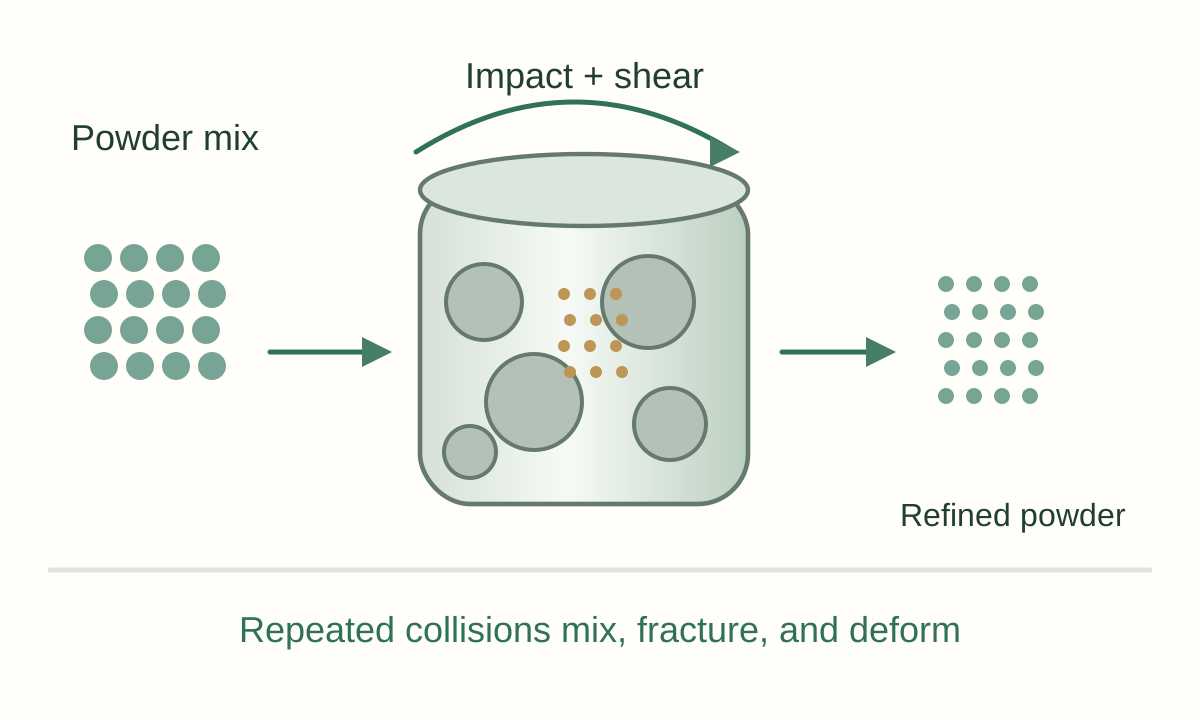
Ball milling / mechanical alloying

Repeated impacts mix and transform powders

Ball milling / mechanical alloying: Repeated impacts mix and transform powders. Clear vector schematic of the basic process.
Scientific principle schematic · tap to enlarge

Principle

Powders and milling balls move inside a jar, producing repeated impacts and shear. Milling can reduce particle size and improve mixing; under suitable conditions, fracture and cold welding can also drive mechanical alloying. For ceramic precursor preparation, milling may be followed by a separate high-temperature reaction.

Outcome

Homogeneous precursor mixtures, refined powders, and mechanically alloyed materials.

What controls the outcomeJar and ball composition, milling energy, atmosphere, and time affect contamination and reproducibility.

Read the scientific principle ↗
12

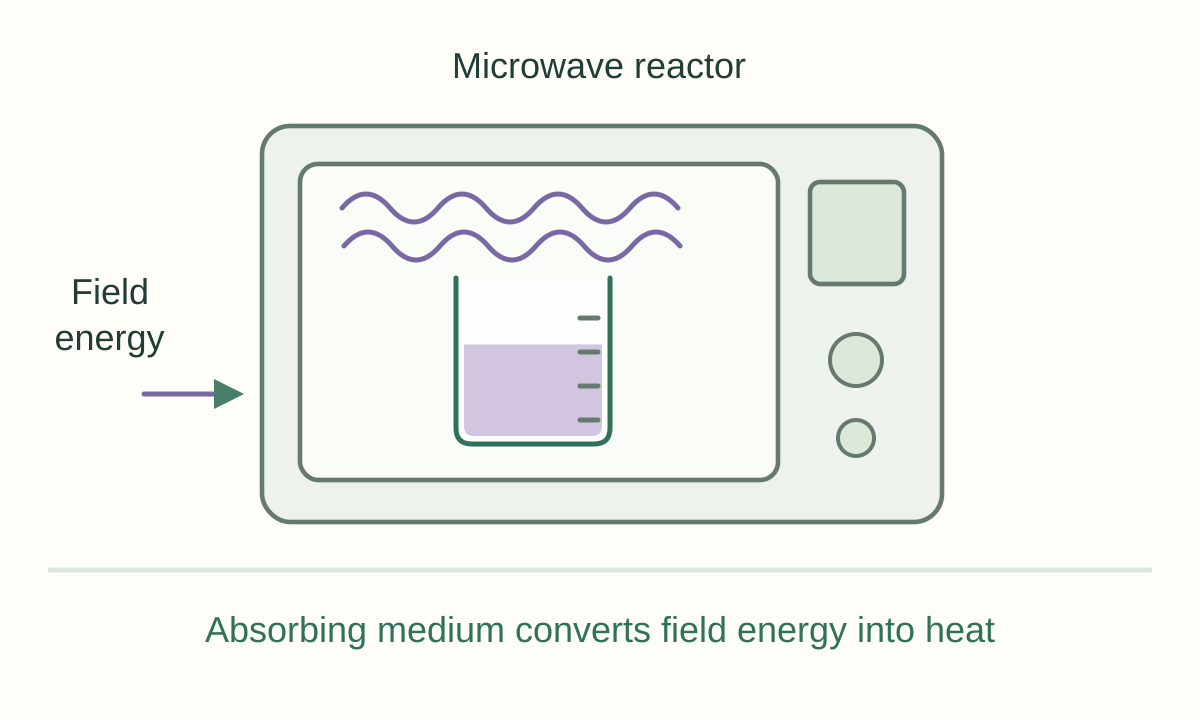
Microwave-assisted synthesis

Electromagnetic energy heats the reaction medium

Microwave-assisted synthesis: Electromagnetic energy heats the reaction medium. Clear vector schematic of the basic process.
Scientific principle schematic · tap to enlarge

Principle

Microwaves couple to absorbing components through dielectric loss, including dipolar and ionic processes. Heat is generated within the reacting medium, which can change the heating rate compared with conventional external heating. Reaction temperature, pressure, and microwave absorption still need control; the method does not heat every solvent equally.

Outcome

Rapidly heated solution reactions and selected solid-state transformations.

What controls the outcomeAbsorption, reactor geometry, and thermal uniformity determine the practical benefit.

Read the scientific principle ↗
13

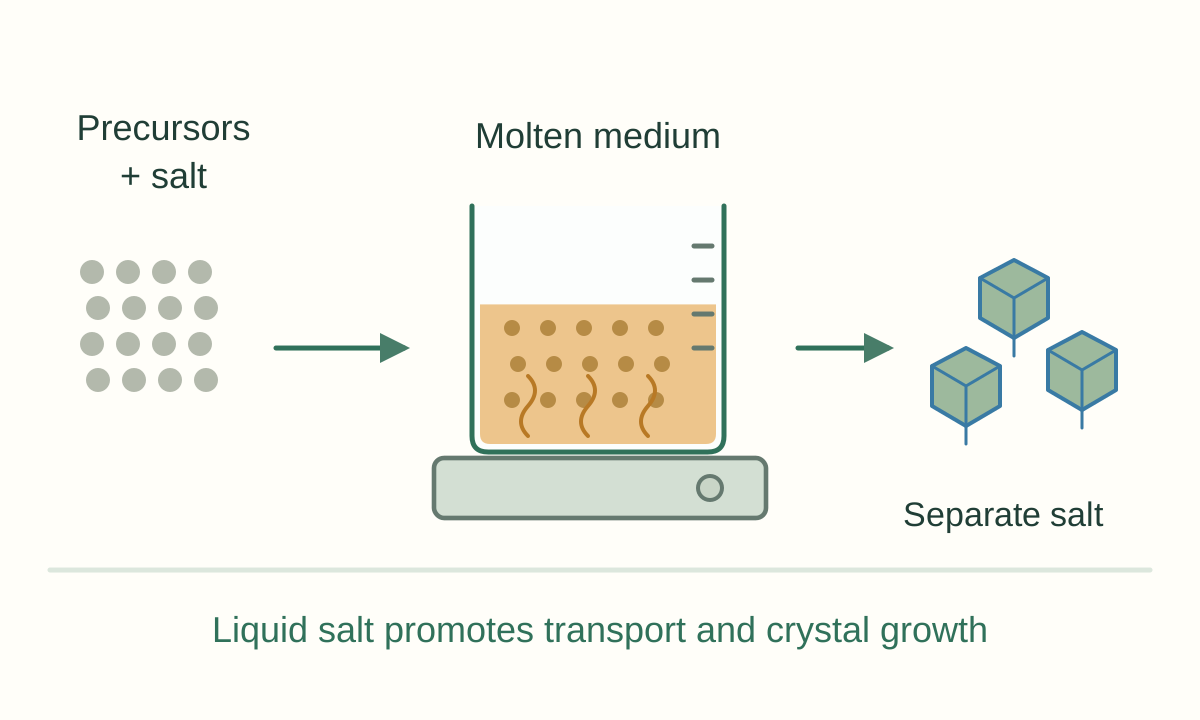
Molten-salt synthesis

A liquid salt supports transport and growth

Molten-salt synthesis: A liquid salt supports transport and growth. Clear vector schematic of the basic process.
Scientific principle schematic · tap to enlarge

Principle

Precursors are heated with a salt or salt mixture above its melting point. The liquid medium helps transport reacting species and can promote crystal growth or phase formation. After cooling, a compatible washing or separation step removes the salt and isolates the product.

Outcome

Crystalline inorganic powders and selected MAX-phase or related materials systems.

What controls the outcomeSalt chemistry, temperature, solubility, and washing compatibility affect the resulting phase.

Read the scientific principle ↗
14

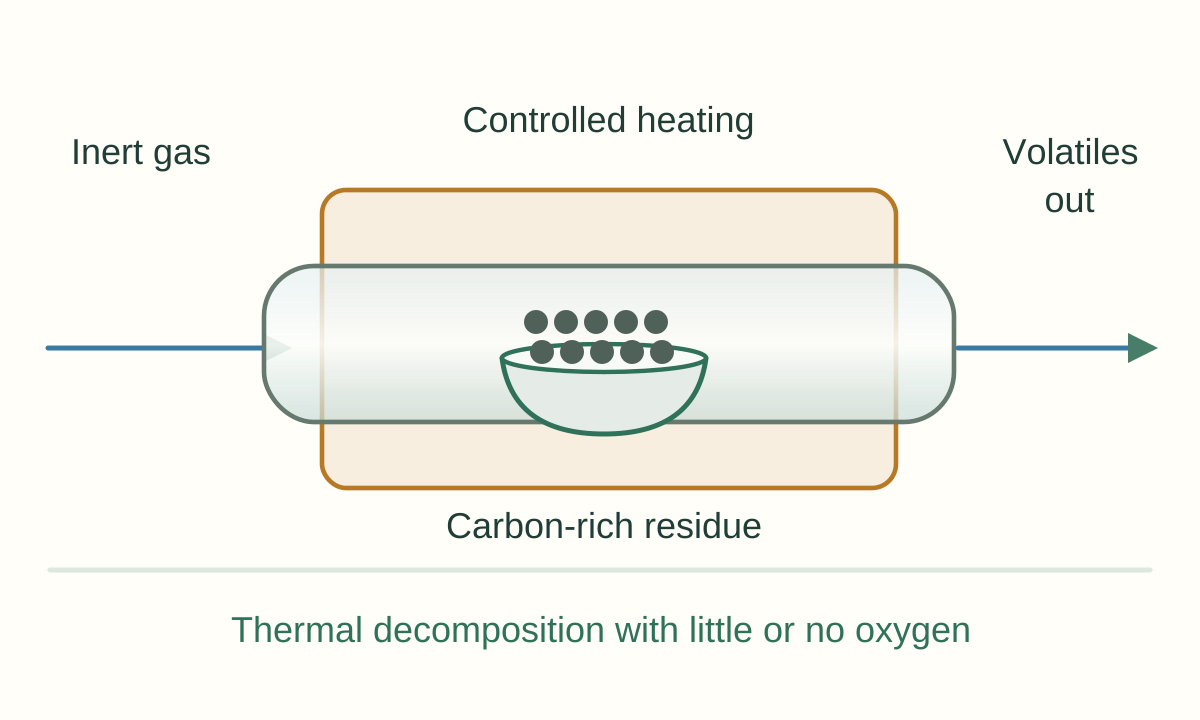
Pyrolysis / carbonization

Heat transforms a precursor in a controlled atmosphere

Pyrolysis / carbonization: Heat transforms a precursor in a controlled atmosphere. Clear vector schematic of the basic process.
Scientific principle schematic · tap to enlarge

Principle

An organic or composite precursor is heated with little or no oxygen, causing bonds to break and volatile products to leave. The remaining solid can become carbon-rich, and its structure evolves with temperature and atmosphere. Carbonization is a carbon-forming type of pyrolysis; additional activation can be used when a porous carbon is required.

Outcome

Carbon materials and thermally transformed composites.

What controls the outcomePrecursor chemistry, gas environment, heating rate, and dwell time control yield and structure.

15

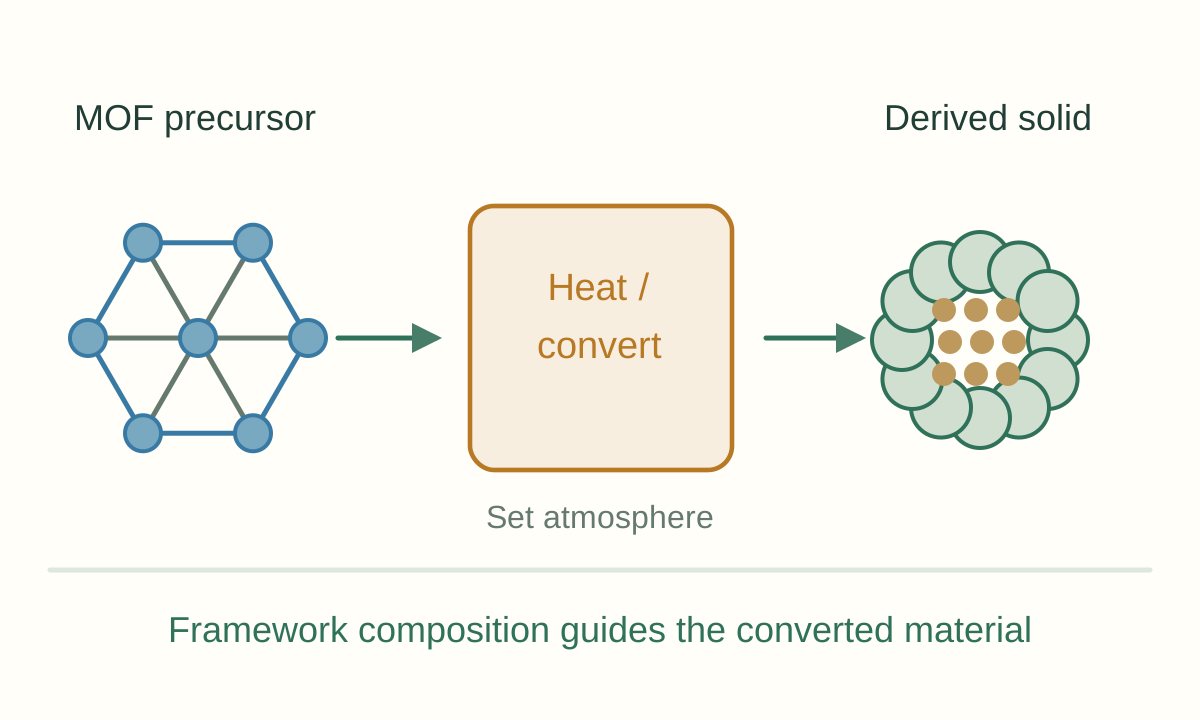
MOF-derived synthesis

A framework becomes a functional solid

MOF-derived synthesis: A framework becomes a functional solid. Clear vector schematic of the basic process.
Scientific principle schematic · tap to enlarge

Principle

A metal–organic framework supplies spatially distributed metal nodes and organic linkers. Heating or chemical conversion transforms that precursor into a new material, such as a metal-containing carbon composite or an oxide. Product identity depends on the framework, atmosphere, and conversion conditions; retaining the original shape does not guarantee retention of its original pore structure.

Outcome

Porous carbons, metal-containing composites, and selected oxide or nitride products.

What controls the outcomePhase evolution, particle coarsening, and residual species must be checked after conversion.

Read the scientific principle ↗
How do we verify what we made?

Connect synthesis choices to structure, composition, surfaces, and optical response.

Explore characterization ↗